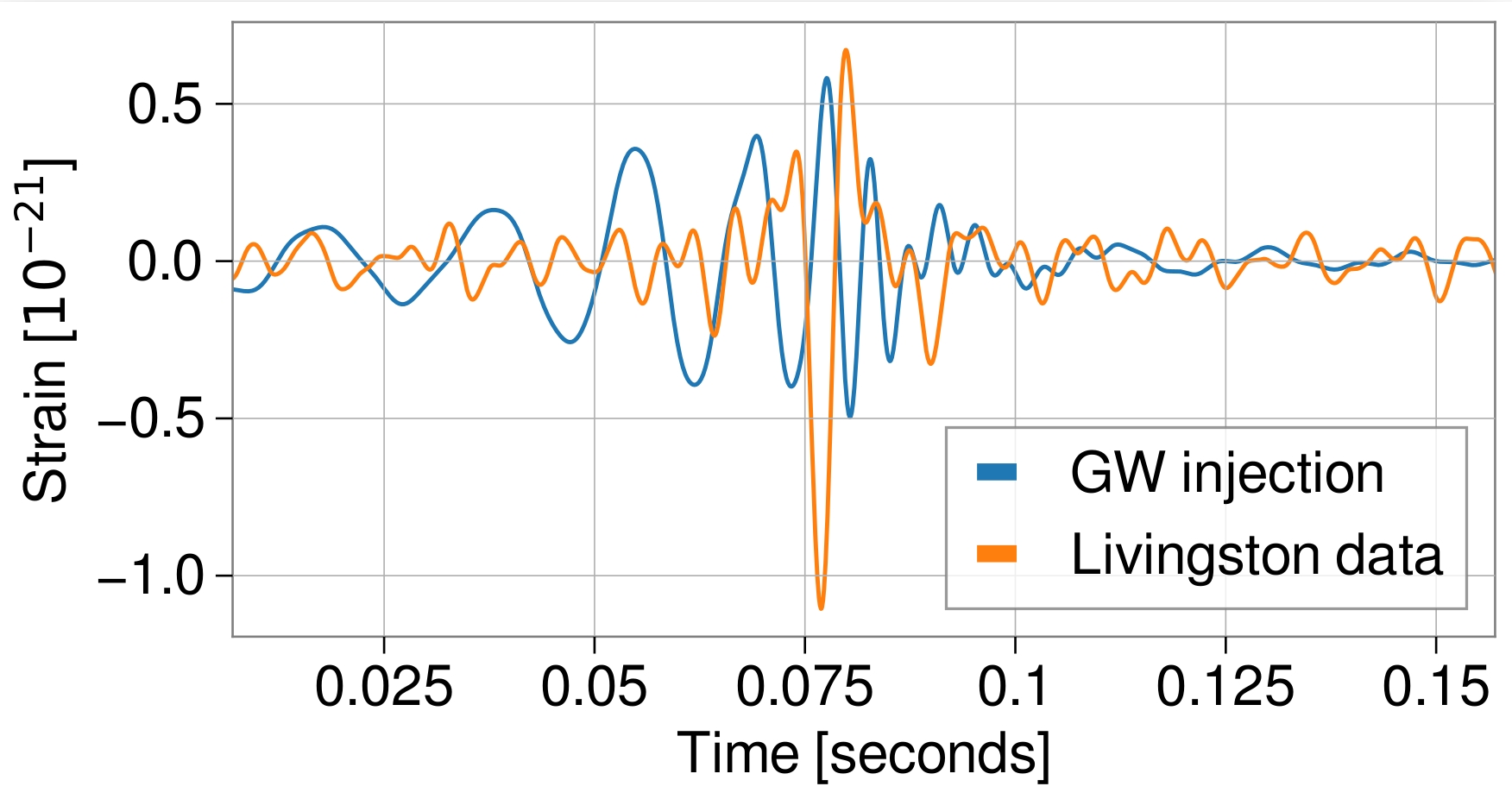
Gravitational-wave data often contains noise artifacts (also called glitches).
In fact, about 24% of gravitational-wave candidates during the third LIGO-Virgo-KAGRA observing run had a glitch nearby.
A glitch can be confused with a gravitational-wave signal causing incorrect estimation of source parameters.
One example of a problem arising from confusing glitches with astrophysical signals is the incorrect sky localization of the signal. If the sky localization of an astrophysical signal is incorrectly determined, an electromagnetic counterpart is less likely to be detected. This would result in losing loads of information about the source of gravitational waves.
I tested how different glitches affect the sky localization of various astrophysical signals (binary black holes, binary neutron stars, and neutron star-black hole binary). I found that short signals, such as binary black holes, are not usually affected by glitches unless they exactly overlap (see the image above). However, longer-duration signals like a neutron star-black hole binary are affected by glitches.
Read the paper on arXiv , published in Physical Review D.