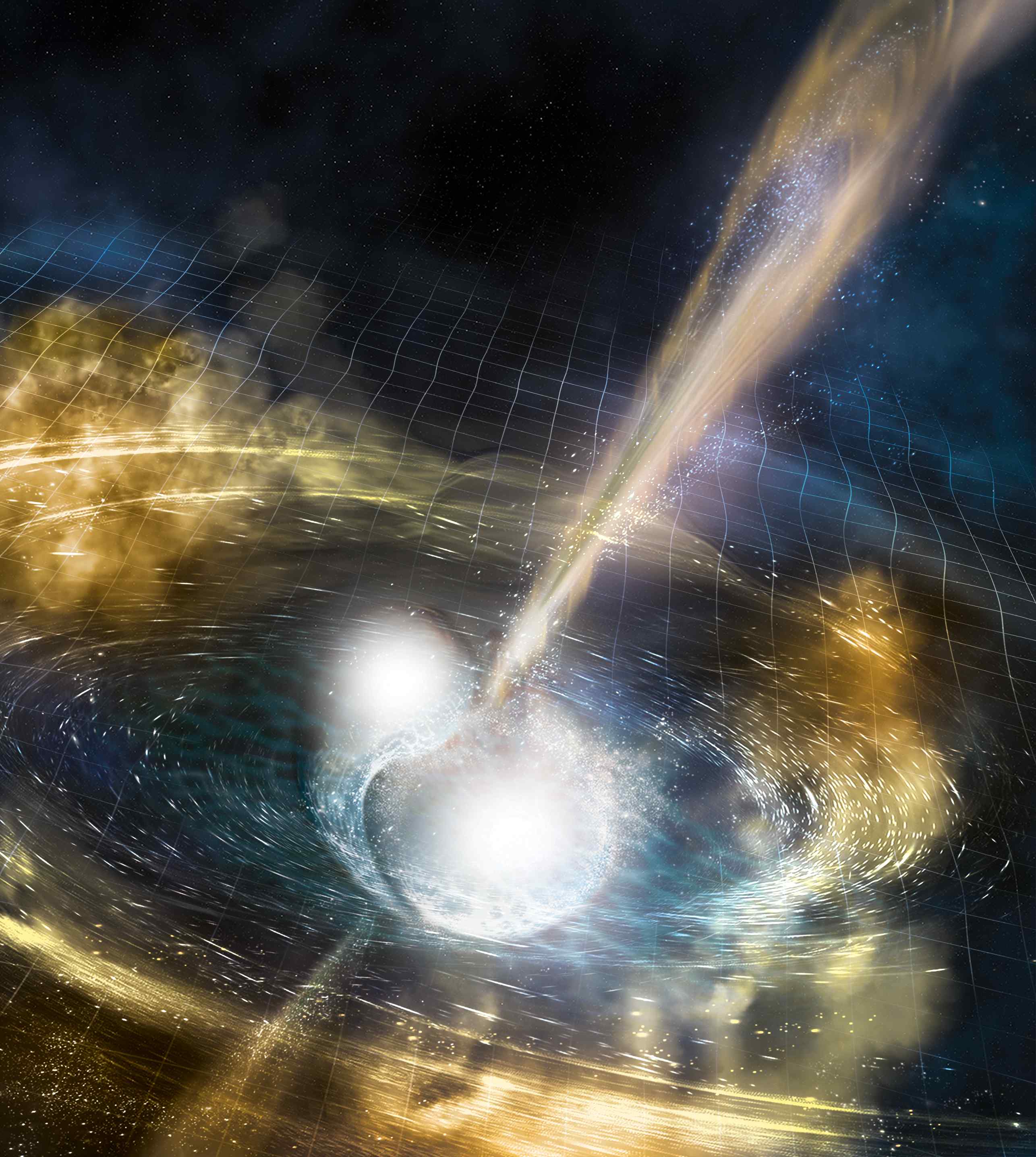
Gamma-ray bursts are extremely energetic explosions, first observed in the 1960s with satellites built to detect nuclear explosions on Earth. There are two scenarios of how such energetic bursts can be formed naturally: by a collision of two stars (e.g., neutron stars) or when a massive star reaches the end of its life and implodes. In both cases, we also expect gravitational waves to be produced due to the large quadrupole moment.
Advances in satellites and observing techniques now allow about one gamma-ray burst to be observed daily. However, many of these bursts are so distant that gravitational-wave detectors cannot find the counterparts for these bursts using usual gravitational-wave searches. As a result, we perform a subthreshold coincident search which is more efficient because the time and location of a gamma-ray burst is known.
I analyzed the data around tens of gamma-ray bursts throughout the second and third LIGO-Virgo-KAGRA observing runs, including the famous GW170817–GRB 170817A. In addition, I led the analysis group that searched for unmodeled gravitational waves in coincidence with gamma-ray bursts. As a group leader, I presented the analyses and results at various conferences and seminars.
For more details, see the collaboration papers published in ApJ: O2 search results , O3a search results , O3b search results , GW170817 and GRB 170817A .