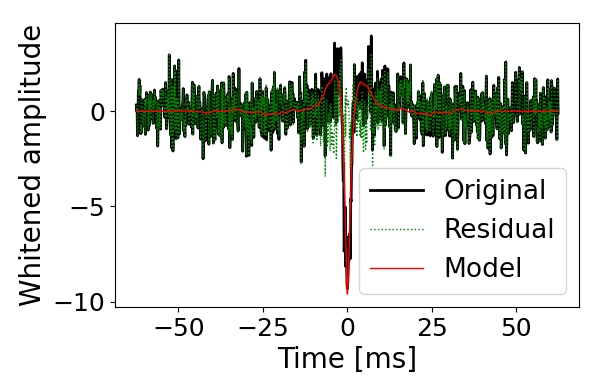
The excess noise in gravitational-wave data can be categorized into different classes based on the noise morphology.
Some excess noise is very short and well-localized in time, e.g. so-called blips, while other noise sometimes lasts minutes, for example, light scattering noise.
In this project, my collaborators and I made a quasi-physical model for three classes of noise: blips, tomte and koi fish. The model has five parameters: amplitude, time, phase, frequency and bandwidth. Using JAX, we fit these five parameters to the gravitational-wave data which allows us to precisely model the excess noise. Once the excess noise is modeled, it can be removed from the data thus allowing for more accurate estimation of astrophysical source parameters.
Read the paper in Physical Review D or the free version on arXiv .